The Industrial Impact of the 2025 Chemistry Nobel: How MOFs Are Reshaping the Plastics Industry
For decades, plastics have been passive materials—valued for durability, flexibility, and cost-efficiency, but fundamentally limited in function. That paradigm is now beginning to shift.
The awarding of the 2025 Nobel Prize in Chemistry to Professor Susumu Kitagawa of Kyoto University—jointly with Professor Richard Robson (University of Melbourne) and Professor Omar M. Yaghi (University of California, Berkeley)—marks more than a scientific milestone. It signals a structural shift in how materials are designed, manufactured, and deployed across industries.
While Robson first proposed the conceptual framework in the late 1980s and Yaghi coined the term "MOF" and demonstrated their permanent porosity, Kitagawa's distinctive contribution was the development of flexible, dynamically responsive porous coordination polymers (PCPs)—a class of materials whose pores can open, close, and adapt to guest molecules. It is this dynamic, "soft" porosity that has opened a new frontier for embedding nanoscale functionality into engineered material systems, including polymers.
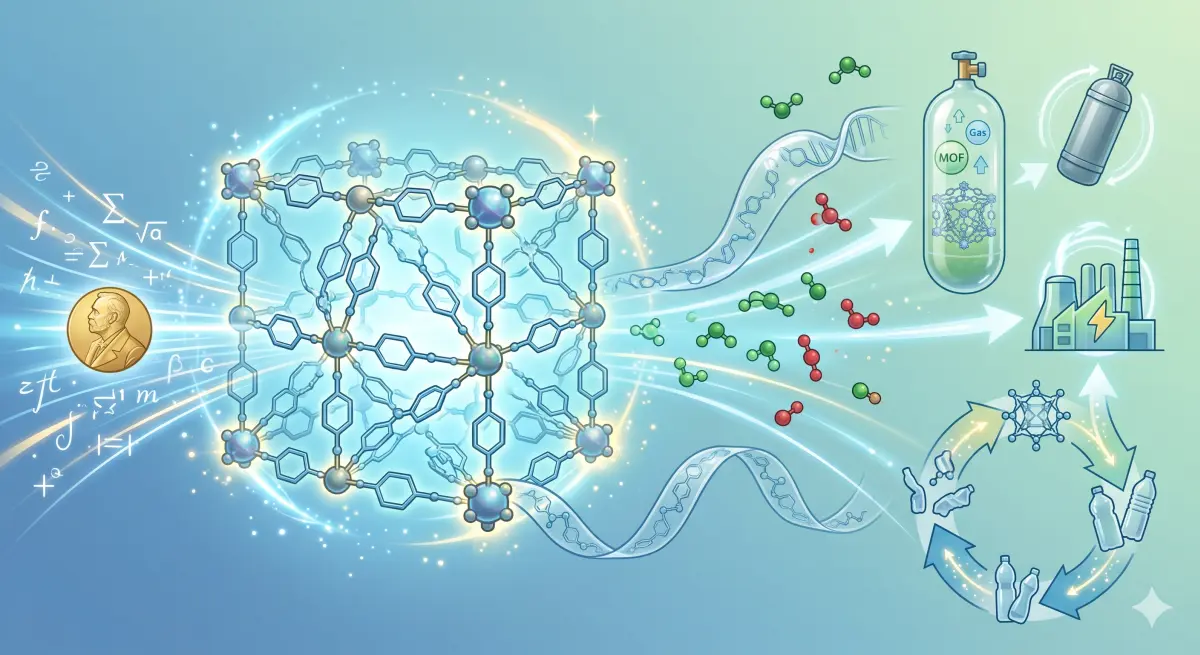
In simple terms, MOFs are highly ordered, microporous crystalline materials in which metal ions (or metal clusters) are linked by organic ligands to form three-dimensional coordination networks—often described as a molecular "scaffold" or "jungle gym." But their significance goes far beyond structure. The collective work of the 2025 laureates redefined how chemists think about space within materials, transforming empty volume into a controllable, functional domain.
Today, that concept is moving from the laboratory toward the plastics industry.
From Passive Materials to Functional Systems
One of the longstanding challenges with MOFs has been their physical form. Typically produced as crystalline powders, they are difficult to process into practical shapes. Progress has come through integration with polymers.
Building on Kitagawa's foundational insights into porosity, a broader research community has pursued strategies to integrate MOFs into processable forms. The most commercially advanced approach is the development of Mixed Matrix Membranes (MMMs), pioneered through decades of work in membrane science. By dispersing MOF particles into polymers such as polyimide or polysulfone, researchers have created hybrid materials that combine the flexibility and manufacturability of plastics with the molecular-level selectivity of MOFs.
This enables a capability traditional plastics never had: precise gas separation at the nanoscale.
A further direction is the emergence of PolyMOFs, where polymer chains themselves are incorporated as ligands within the MOF structure. These materials blur the boundary between framework and polymer, and early studies suggest they could yield flexible, porous systems with potential to bend, stretch, and respond to environmental stimuli. PolyMOFs remain at an early research stage, but represent a promising design direction.
The broader implication is clear: plastics are beginning to evolve from purely structural materials into functional systems with embedded molecular-level capabilities.
Reshaping Manufacturing: Energy, Efficiency, and Scale
The industrial impact of MOFs is particularly significant in process optimization—especially in energy-intensive sectors.
Take ethylene/ethane separation, a cornerstone of polyethylene production. Current processes rely on cryogenic distillation at extremely low temperatures, consuming vast amounts of energy across the petrochemical industry.
MOFs offer an alternative. By selectively adsorbing specific molecules, they enable gas separation under near-ambient conditions. Process modeling studies suggest that, under favorable conditions, energy consumption in ethylene/ethane separation could be reduced by up to roughly 40% compared with cryogenic distillation. These figures are based on simulations rather than full commercial deployment, and challenges such as long-term membrane stability and plasticization remain active areas of research.
Even so, the directional opportunity is substantial. If validated at scale, lower energy use would translate into reduced operating costs and significantly lower carbon emissions, aligning with global decarbonization targets.
Turning Waste into High-Value Materials
Another area where MOFs are gaining traction is plastic recycling—specifically, upcycling.
Recent research has demonstrated that terephthalic acid recovered from waste PET bottles can serve as an organic linker for well-known MOFs such as MOF-5, MIL-53, and UiO-66. Rather than degrading plastics into lower-value materials, this approach points toward a future in which waste could become a feedstock for advanced functional systems.
At present, the economics still favor virgin terephthalic acid in most cases, and large-scale industrial implementation remains a goal rather than current practice. Even so, the conceptual shift is significant: plastic waste is no longer treated solely as an endpoint, but increasingly as a potential resource for next-generation materials.
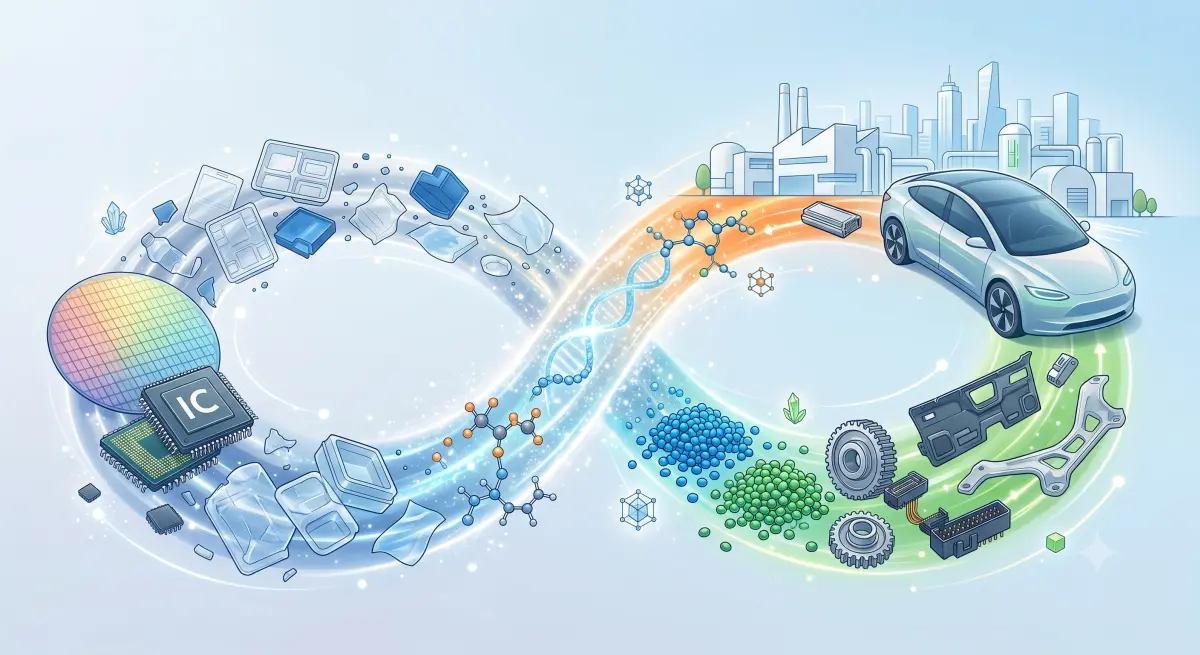
Such developments are closely aligned with circular economy strategies, where sustainability and performance are increasingly seen as mutually reinforcing rather than in tension.
From Breakthrough to Market: The Role of Startups
The transition from academic discovery toward industrial application is already underway.
A notable example is Atomis, a Kyoto University spin-off working to commercialize MOF technologies. The company has partnered with major industrial players, including Daikin Industries, to explore MOF-based gas separation systems in real-world applications such as refrigerants.
Atomis is also developing lightweight, MOF-integrated gas containers (such as the CubiTan® platform), currently deployed for specialty gases including methane and CO₂. In the longer term, such containers could complement or replace heavy steel cylinders traditionally used for gas storage, potentially contributing to improved safety, reduced transportation costs, and broader adoption of hydrogen and other clean energy carriers as the technology matures.
This is where the foundational research of the 2025 laureates begins to translate into tangible industrial value.
Why This Matters Now
For years, MOFs were viewed as a promising but largely academic field. That perception is changing.
With Nobel recognition, MOFs have entered a new phase—one increasingly defined by industrial adoption in selected applications, cross-sector collaboration, and accelerated investment.
For the plastics industry, this is not just another material innovation. It is a platform technology that, over time, could enable simultaneous progress in three critical areas:
- Lightweighting
- Functional performance
- Decarbonization
Few emerging technologies offer this combination.
The Strategic Takeaway
The message for industry leaders is straightforward.
MOFs are no longer purely a future possibility—they are becoming a present competitive factor in selected applications, with broader industrial adoption likely to follow over the coming decade. Companies that begin engaging with MOF-based approaches today will be better positioned to lead as the field matures. Those that delay risk falling behind as the definition of "plastic" itself continues to evolve.
In that sense, the 2025 Nobel Prize is not just recognition of past achievement. It is a signal of where the materials industry is heading next.
And that future has already begun to take shape.