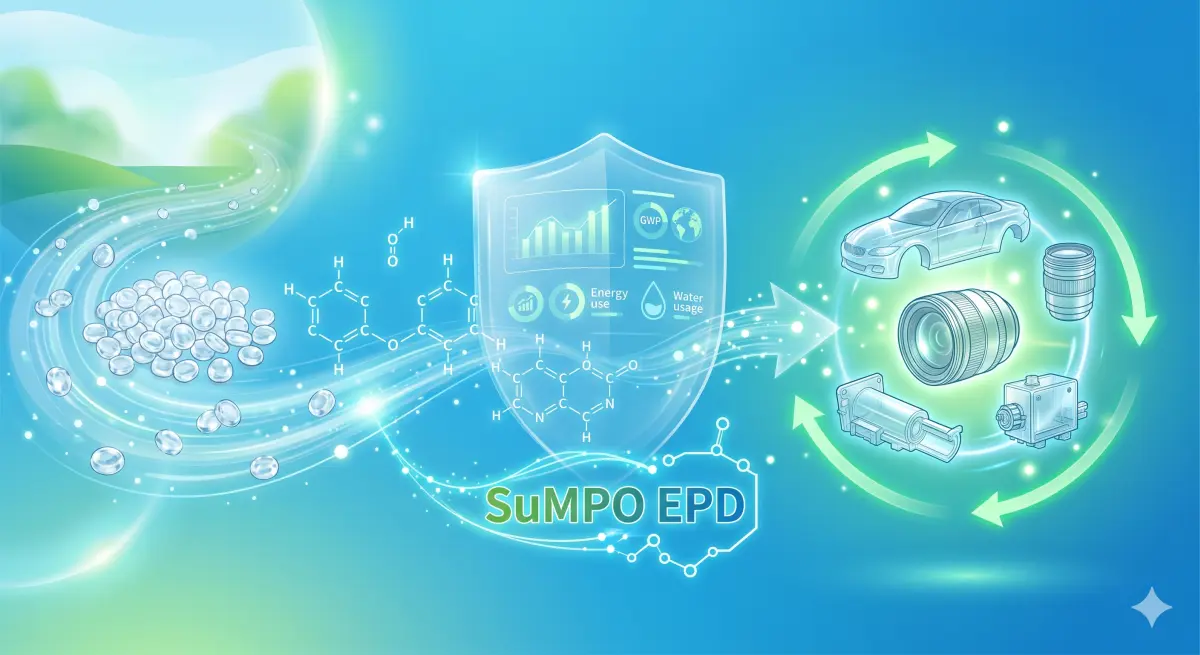
Teijin announced on February, 2026, that it has registered its virgin resin materials—including polycarbonate (PC) resins—under the environmental labeling program SuMPO EPD (Environmental Product Declaration). This marks the first time in Japan that virgin resin materials have been registered under the SuMPO EPD framework. By visualizing the environmental impact of its materials, Teijin aims to enhance transparency and support customers in reducing CO₂ emissions across the entire supply chain.
Rising Demand for Greater Transparency in the Environmental Impact of Resin Materials
In recent years, the manufacturing sector has faced growing pressure to quantify carbon footprints (CFP) as part of efforts to achieve carbon neutrality by 2050. A Product Carbon Footprint (PCF) measures greenhouse gas (GHG) emissions across a product’s entire lifecycle—from raw material extraction to disposal and recycling—expressed as CO₂-equivalent emissions. By translating environmental impact into measurable data, PCF enables companies to identify concrete opportunities for reducing emissions.
In Japan, the Ministry of Economy, Trade and Industry (METI) and the Ministry of the Environment (MOE) are supporting this transition through initiatives such as the CFP Calculation Rule Formulation Support Program, which promotes the development of standardized calculation rules across industries and product categories. Some sectors—most notably the automotive industry—are already making progress in managing emissions across their entire supply chains. However, accurately quantifying the environmental impact of resin materials remains a significant challenge. This is due to several factors, including the complexity of upstream petrochemical supply chains, limited data availability, and the wide variety of manufacturing processes involved. As a result, many calculations still rely on industry-average emission factors, making it difficult to reflect the actual CO₂ reduction efforts of individual resin manufacturers. Against this backdrop, there is a growing need to establish dedicated calculation frameworks tailored specifically to resin materials.
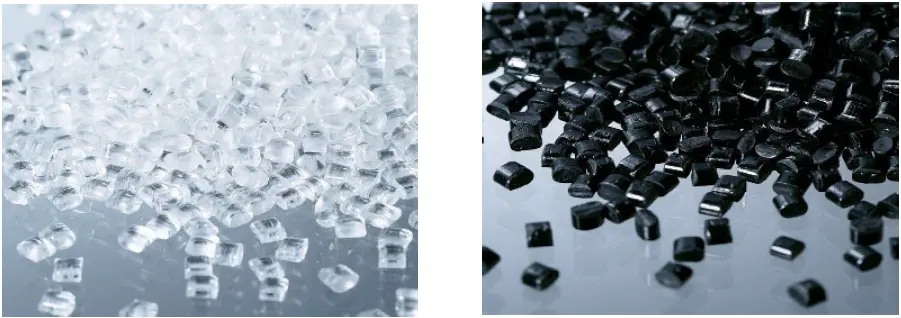
Polycarbonte (PC) Resin Panlite® & Multilon®
Photo courtesy of Teijin
How SuMPO EPD Works—and What Makes It Valuable
The SuMPO EPD adopted by Teijin is an environmental labeling program operated by the Sustainable Management Promotion Organization (SuMPO). Based on Life Cycle Assessment (LCA) methodologies, the scheme quantifies, verifies, and publicly discloses environmental impact data for a wide range of products. Key indicators—such as Global Warming Potential (GWP), energy consumption, and water usage—are reported in accordance with Product Category Rules (PCR), which are defined for each product category to ensure consistency and comparability.
For this registration, Teijin calculated CO₂ emissions using primary data for its Panlite (PC resin) and Multilon (PC/ABS alloy). Following third-party verification, both materials were successfully registered under SuMPO EPD. This enables users to directly compare environmental performance at the material selection stage—an increasingly important factor in product design and procurement. Notably, these materials have already been adopted by Canon Inc. for use in two models of commercial production printers. The environmental data was incorporated into Canon’s own lifecycle CO₂ assessments, ultimately supporting the company’s own SuMPO EPD registration and disclosure.
Competition to Disclose Low-Impact Materials Is Accelerating
Efforts to visualize and disclose environmental impact are rapidly gaining momentum across the materials industry. For example, Mitsubishi Chemical Group is advancing the development and supply of chemically recycled materials, strengthening its initiatives to reduce environmental impact. Meanwhile, BASF calculates the Product Carbon Footprint (PCF) for its products and provides this data directly to customers, supporting more informed material selection. Against this backdrop, the EPD registration of virgin resin materials is likely to emerge as a new benchmark in the industry. Looking ahead, as the range of registered products expands and similar initiatives are adopted across other resin types, the potential for meaningful CO₂ emission reductions across the entire supply chain is expected to grow significantly.