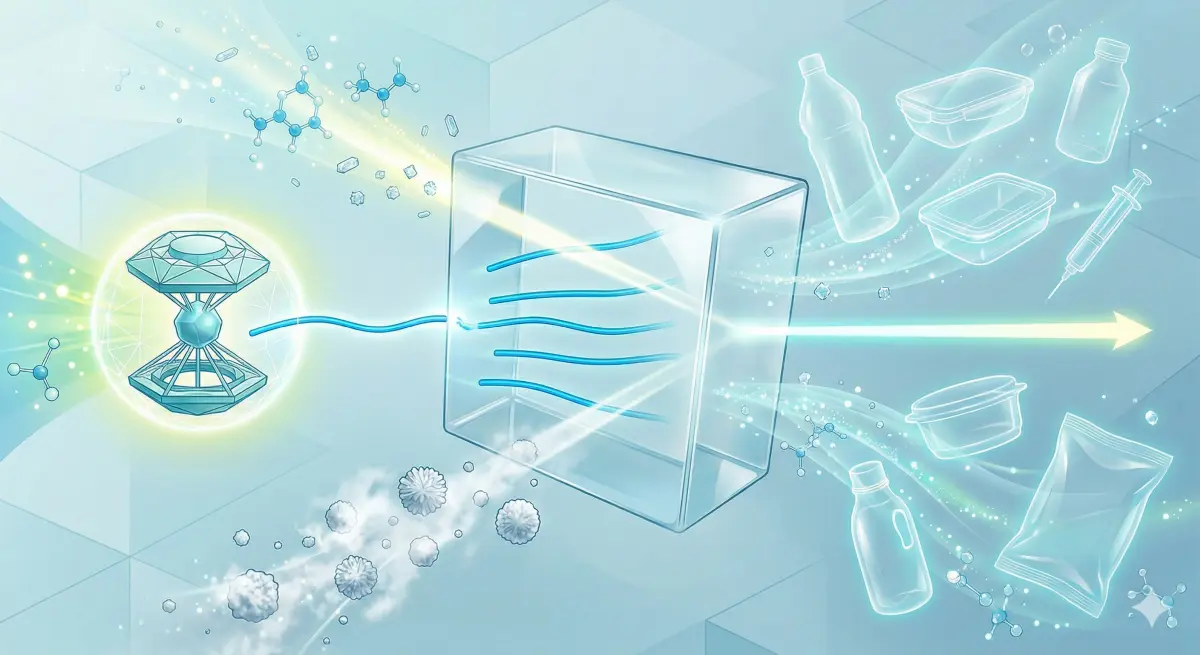
In November 2025, Japan Polypropylene Corporation announced that it had developed a new polypropylene (PP) resin with exceptionally high transparency.
Why Is PP Difficult to Make Transparent?
Across applications such as food packaging, consumer goods, and medical applications, demand is growing for materials that combine high transparency with reduced weight. PP is lightweight and easy to process, but it has traditionally been inferior to PS and PET in terms of transparency.
This limitation stems from the fact that PP is a semicrystalline resin. During cooling from the molten state, it forms spherical crystalline structures known as spherulites. These structures readily scatter light. As a result, making it inherently difficult to achieve high transparency in PP.
Proprietary Metallocene Catalyst Technology
To develop this highly transparent PP, the company combined its long-established materials design technology with WINTEC, a polypropylene produced using its proprietary metallocene catalyst technology.
A metallocene catalyst is a single-site catalyst with uniform active sites, which enables the production of polymers with a narrow composition distribution and excellent copolymerization properties. By leveraging its proprietary complexation design and catalyst support technologies, the company addressed key challenges, including catalyst activity and control over the degree of polymerization in random copolymers. In 2001, the company commercialized WINTEC, the world’s first random copolymer produced using a metallocene catalyst.
WINTEC contains minimal amounts of low-crystallinity and low-molecular-weight components and features a uniform molecular structure. Compared with products made using conventional catalysts, it offers superior transparency, as well as a lower melting point, reduced contamination, and fewer extractable substances.
High Transparency with a Haze Value of 1.5%
The newly developed material exhibits one of the highest levels of transparency ever achieved for polypropylene (PP). Its haze value—an indicator of the degree of cloudiness in transparent materials—was 1.5%, significantly lower than the approximately 15% observed in conventional transparent PP. Lower haze values correspond to greater clarity. Because haze values depend on sample thickness, all values reported here were measured at a thickness of 1 mm.
The company’s proprietary metallocene catalyst technology enables precise molecular control and a uniform molecular structure, which contribute to this high level of transparency in PP.
In terms of physical properties, the melt flow rate (MFR), an indicator of melt flowability, was 30 g/10 min for both the newly developed material and conventional transparent PP. The developed material showed a flexural modulus of 1450 MPa, higher than the 1350 MPa of conventional transparent PP. Its Charpy impact strength at 23°C was 4 kJ/m², slightly lower than the 4.5 kJ/m² of conventional transparent PP.
The company expects that using this new PP as an alternative to PS and PET will reduce product weight, improve transportation efficiency, and help reduce CO₂ emissions.