A joint research team from the Institute of Physical and Chemical Research (RIKEN) and the University of Tokyo has developed a cellulose-based supramolecular plastic derived from wood pulp. The material can be formed simply by mixing the components in water at room temperature. It can be engineered to exhibit various mechanical properties. In addition, it dissociates in saltwater (seawater) and can be regenerated with equivalent quality, enabling “horizontal” (closed-loop) recycling. The work points to a next-generation polymer material that could serve as an alternative to conventional petroleum-based plastics.
A Glassy Plastic Built from a Network Formed by “Supramolecular Ionic Polymerization”
The new plastic is a supramolecular polymer based on sodium carboxymethyl cellulose (CMC), a cellulose derivative. Cellulose is widely available in nature. Supramolecular polymers consist of monomers bonded by reversible non-covalent interactions and can exist in both liquid and solid states. The research team has established the synthetic method they term "supramolecular ionic polymerization." A 2024 Science paper reports several supramolecular plastics developed using it.
In the present study, the researchers found that simply mixing negatively charged CMC and a positively charged sulfate guanidinium monomer (PEIGu) in water at room temperature produces a robust cross-linked polymer network. The network is based on electrostatic interactions (salt bridges) reinforced by hydrogen bonding.
PEIGu is a specifically designed cross-linking species synthesized from polyethylenimine (PEI) in the form of a hyperbranched ion bearing multiple guanidinium groups. When this component is dried, it forms CMCSP, a colorless, transparent, and extremely hard glassy supramolecular plastic. However, it was also found to possess the brittleness characteristic of glass.
Overcoming Brittleness and Tuning Mechanical Properties with Choline Chloride
To address this brittleness, the researchers added choline chloride (ChCl) to CMCSP. ChCl is an FDA-approved, safe, low-cost nutrient (used as a food additive), and the study showed that it acts as a specialized plasticizer for CMCSP.
With ChCl, the mechanical properties of CMCSP can be tuned across a broad range.
Changes in mechanical properties based on ChCl content
Low ChCl content: Glassy and hard, but remains brittle.
Moderate ChCl content: Achieves both "flexibility and toughness."
High ChCl content: Transitions into a soft, extensible elastomer (130% elongation).
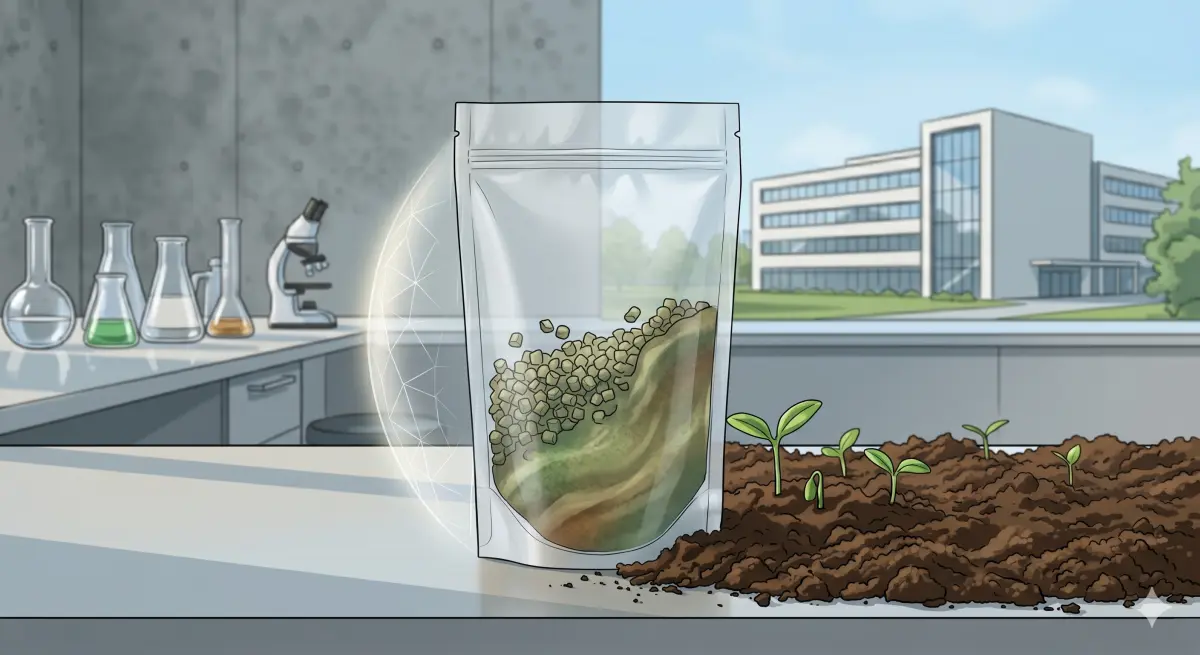
Toughened thin films, even at a thickness of 0.07 mm, have been shown to be difficult to tear by hand if the width is 1 cm or more. The material can also be processed into a mechanically tough flexible bag. Moreover, when protected by a thin hydrophobic coating layer, it remains durable for extended periods in water, including saltwater.
Dissociation in Saltwater and Closed-Loop Recycling
A key functional feature is that when this new supramolecular plastic is immersed in saltwater, the salt-bridge interactions dissociate, returning the material to its constituent molecular components that can be metabolized in natural environments. Through a simple process using ethanol, the components released upon dissociation in saltwater can be separated and recovered, enabling closed-loop recycling without loss of quality. No microplastics are generated. In contrast, conventional fossil-fuel-derived plastics generally require significant energy throughout the various recycling processes.
This achievement builds on the team’s ongoing concept of “supramolecular plastics that dissociate in saltwater and allow straightforward recovery of original components,” realizing a new plastic material derived from cellulose, the most abundant biopolymer on Earth. The novelty lies particularly in resolving the brittleness of cellulose-based CMCSP through the addition of ChCl and expanding its mechanical properties.
The study was published in the Journal of the American Chemical Society on November 19, 2025.